
The Shimmering Promise of the Wind Post Office
Eleven-year-old Harin, lonely after changing schools, discovers mysterious letters in an abandoned lighthouse post office and learns the meaning of true friendship with an unexpected companion.
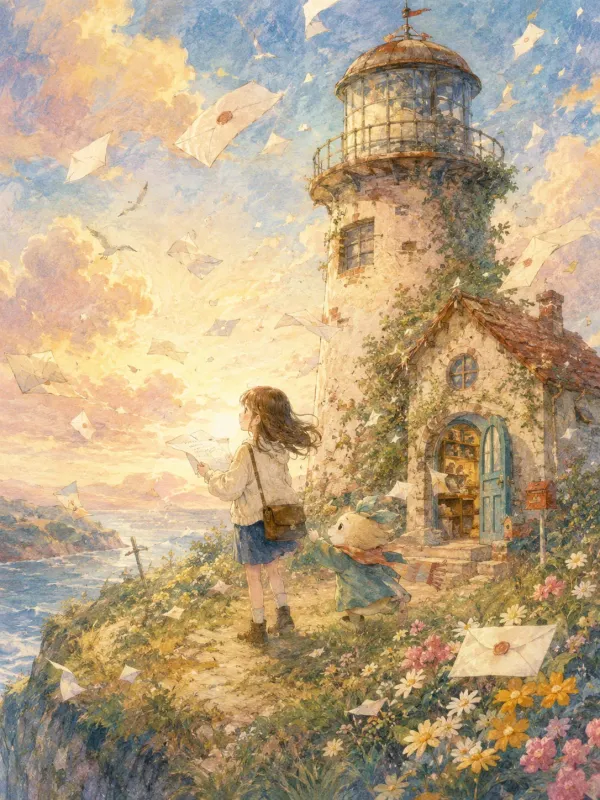
On the tenth morning after Harin moved to the seaside village of Solyeoul, she twisted and untwisted the hem of her new school skirt between her fingers. Outside the window, gulls flew through white clouds like crumbs of bread, and far away an old lighthouse blinked faintly in the mist. Her mother held out her lunch bag and said, ‘Maybe today you could say hello first to someone.’ Harin nodded, but the inside of her throat felt as hard as a seashell.
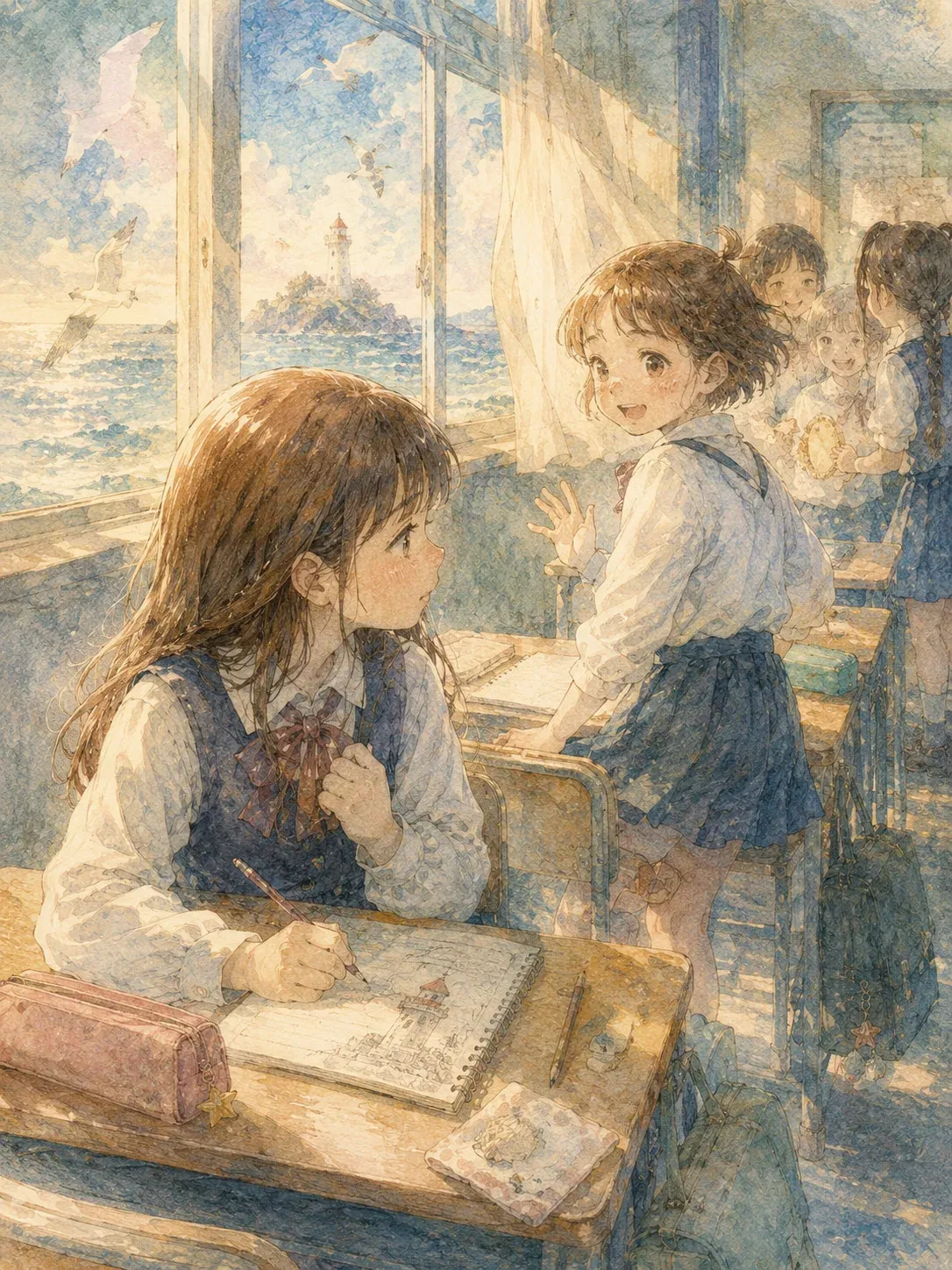
The playground at her new school glittered with tiny crushed shells mixed into the sand. The children laughed as if they had known one another’s nicknames and secrets forever. Harin held her backpack straps tightly and sat in the last seat of the classroom. During every break, the girls talked about jump-rope games, choir auditions, and next week’s sea festival, while Harin drew a little mailbox in the corner of her notebook with the tip of her pencil.
At lunchtime, a girl named Soyul turned around from the desk in front of her. Soyul wore her hair in a short ponytail, and her eyebrows rose bravely whenever she spoke. ‘You draw well. Is that mailbox the one beside the lighthouse? ’ Harin tried to answer, but another child called Soyul’s name. Soyul waved as if to say sorry and ran off. In Harin’s heart, a small door opened and then seemed to slam shut again in the wind.
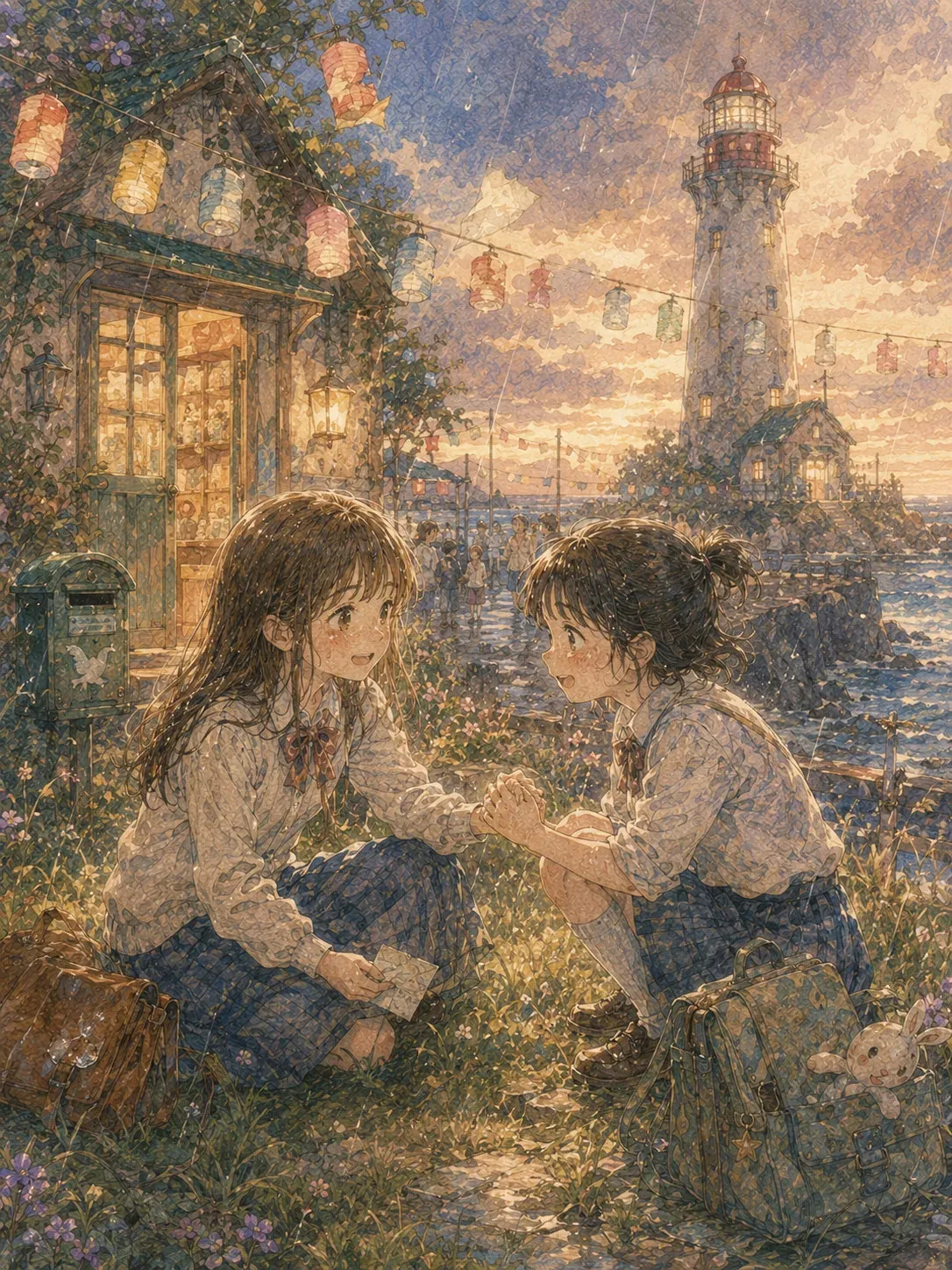
After school that day, Harin did not go straight home. She climbed the hill road toward the lighthouse. Purple seaside daisies lifted their faces along the path, and the smell of wet wood mixed with the salty wind. Beneath the lighthouse stood an old building with a green roof. Above its door, a faded sign read ‘Wind Post Office. ’ The door was not locked, and when Harin pushed it open, the quiet scent of paper dust and dried lavender drifted out.
No one was inside. There was an old service window, a rusty scale, a faded stamp album, and a large sorting case in the middle of the wall. Instead of names, each compartment had a picture: a star, a shell, a wave, a crescent moon. When Harin touched the compartment marked with the crescent moon, a thin envelope dropped out. It had no sender and no receiver. Only these words were written on it: ‘For a child waiting for a friend.’
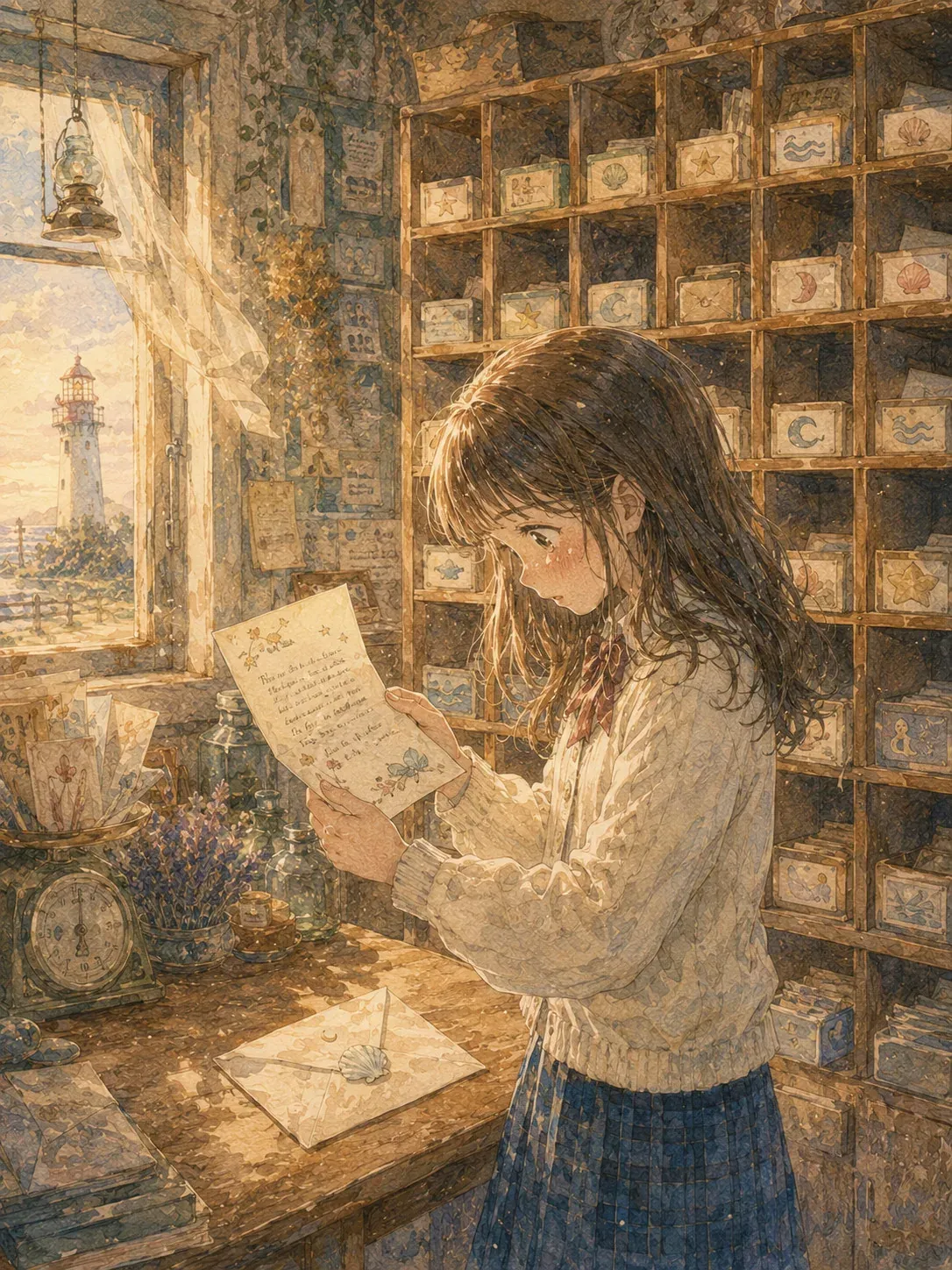
Harin felt her heart beat like a drum as she opened the envelope. Inside was a short letter written in silver ink. ‘A true friend tries to hear the sound of your heart even on your quietest days. But you must open the door a little, too. ’ Beneath the letter was a small piece of a map, showing the breakwater where the sea festival would be held and the camellia tree behind the school. Harin thought it might be someone’s trick, yet a strange warmth remained in her fingertips.
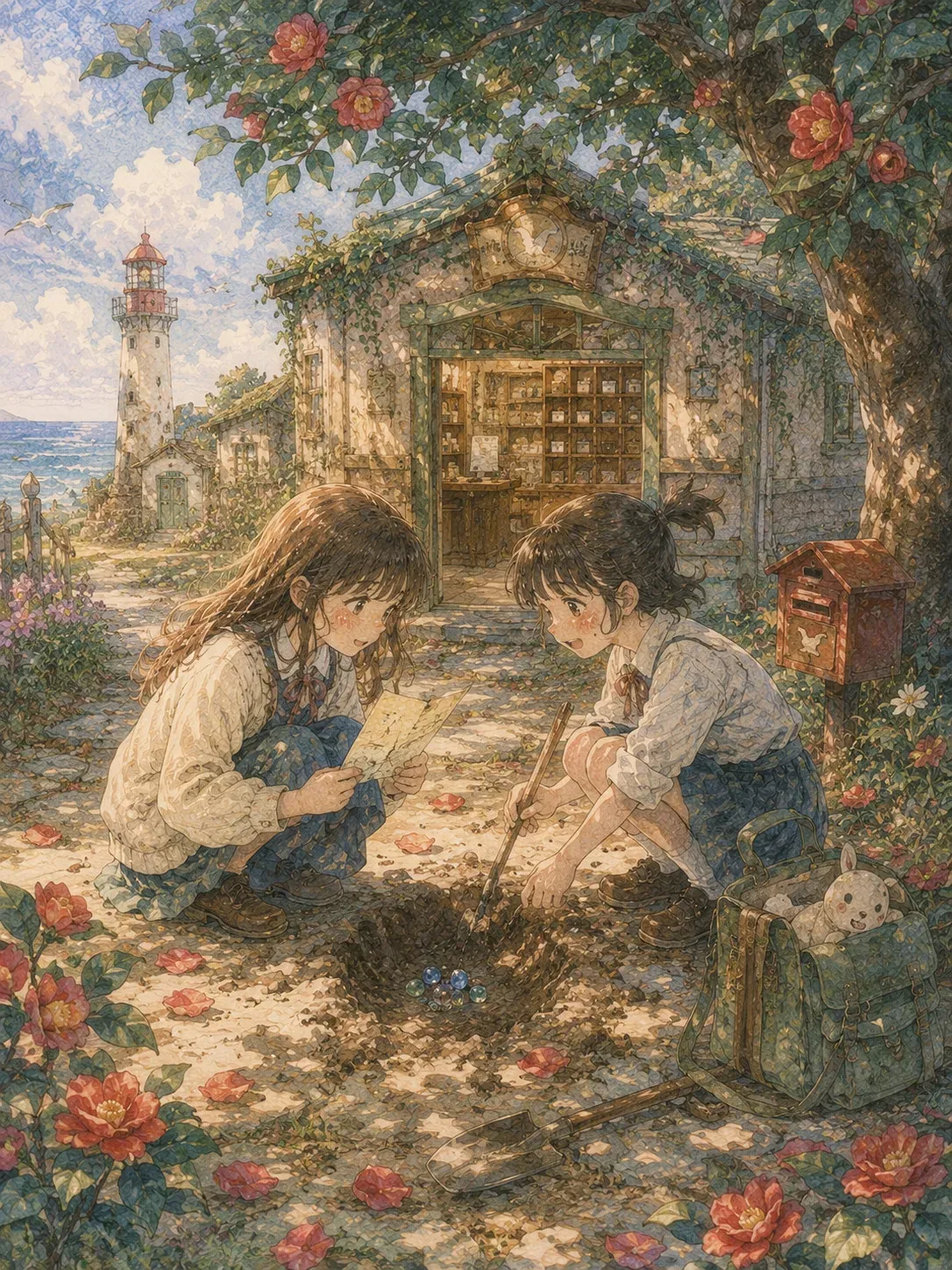
The next day, Harin found Soyul under the camellia tree. Soyul was digging in the ground, grass stains on her knees. ‘I’m looking for marbles my little brother buried. We were going to use them for festival decorations, but they disappeared. ’ Harin hesitated, then pulled the map piece from her bag. ‘There’s a mark here. ’ Soyul’s eyes widened, and she handed Harin a twig instead of a shovel. The two girls began digging silently. Soon three blue glass marbles shone in the sunlight like drops of water.
After that, Harin and Soyul stopped by the Wind Post Office every afternoon. One day, a letter from the shell compartment said, ‘For someone searching for a lost laugh,’ and the girls asked a sixth grader who always sat alone to help color the festival posters. Another day, a note from the star compartment said, ‘For someone who needs an old apology,’ and Soyul spoke first to Minjae, a friend she had argued with the year before. Somehow, the letters always shone a little light on one corner of someone’s heart, and as Harin and Soyul followed that light, they grew closer.
But the closer they became, the more frightened Harin felt. Soyul smiled easily at everyone, and her voice rang across the playground like a bell by the sea. Harin worried that Soyul would soon return to friends who were older, funnier, and easier to understand. So when Soyul said during the festival meeting, ‘I think Harin should do the main drawing,’ Harin felt pleased and terrified at the same time. As all the children looked at her, her face burned. ‘No. I can’t do things like that,’ she said sharply.
The classroom went quiet. Soyul’s eyes wavered for a moment. During break, Soyul said softly, ‘I didn’t mean to pressure you. ’ Harin wanted to say she was sorry, but the words that jumped out first were, ‘Just don’t bother about me.’ The sentence fell between them like a small stone. Soyul turned away without answering, and that day Harin went to the Wind Post Office alone for the first time.
The post office seemed much darker than before. Wind slipped through the cracks of the old windows and rustled the paper pictures on the sorting case. Harin opened the crescent moon compartment, but there was nothing inside. The star compartment was empty too, and so was the shell compartment. At last she pushed open the one marked with a wave, and a thick envelope fell out. Harin’s name was written clearly on it. The handwriting was familiar. It was Soyul’s.
The letter was filled with crooked but honest sentences. ‘Harin, on your first day I saw you drawing a mailbox in the back of the room. I act like I have lots of friends, but when I think about my best friend Eunseo, who moved away, I start talking too much. If I get quiet, I think I might cry. When I saw your drawing, I thought you might understand my heart. That’s why I wanted to talk to you.’ Harin’s throat tightened as she read. She had believed all the mysterious letters were magic, but some of them had been written secretly by Soyul for other people.
Just then, there was a heavy thud outside the window. Harin ran out and saw that a paper-lantern frame built for the festival had fallen in the strong wind and was rolling toward the breakwater. Farther away, Soyul sat on the rain-slick stones after trying to catch it. Harin ran without thinking. ‘Soyul, give me your hand! ’ Her voice cut through the wind, louder than she had known it could be. Soyul reached out, and Harin pulled with all her strength until her friend was back on her feet.
The two girls sat side by side on the wet grass, breathing hard. Harin took the crumpled letter from her bag. ‘I pushed you away first because I was scared you would leave me. I’m sorry. And thank you for your letter.’ Soyul smiled with raindrops on the tip of her nose. ‘When you didn’t say anything, I thought I was bothering you. From now on, let’s ask instead of guessing.’ Harin nodded. It felt as if both of them were holding the handle of the door in her heart, keeping it from blowing shut again.
On the day of the sea festival, Harin’s large drawing hung at the entrance to the breakwater. In the picture, the Wind Post Office looked a little brighter than it did in real life, and children’s letters floated like starlight in every window. Soyul stood beside Harin holding a box of colored pencils, handing blank postcards to every child who came by. The children wrote about things they were sorry for, things they were thankful for, and words they wanted to give to friends they hoped to make.
As the sun set, the lighthouse beam began to turn slowly. Before closing the post office door, Harin placed a new letter in the crescent moon compartment with Soyul. ‘For a child waiting for a friend. You do not have to be loud to be worth hearing. Just leave the window of your heart a little open. When someone comes near like the wind, you will be able to wave back. ’ Beneath it, Soyul added, ‘And sometimes, it is all right for you to become the wind first.’
From then on, the Wind Post Office became the village children’s secret place of promises. Harin still had many quiet days, but she no longer thought quietness meant loneliness. Soyul still laughed bravely, but sometimes she sat silently beside Harin and listened to the waves. The two girls learned that friendship is not made only of bright, sparkling words. It is made of waiting, courage, and the small choice to reach out again.
The End
That is the story for today
Take a moment to talk about the scene your child remembers most.
ADVERTISEMENT